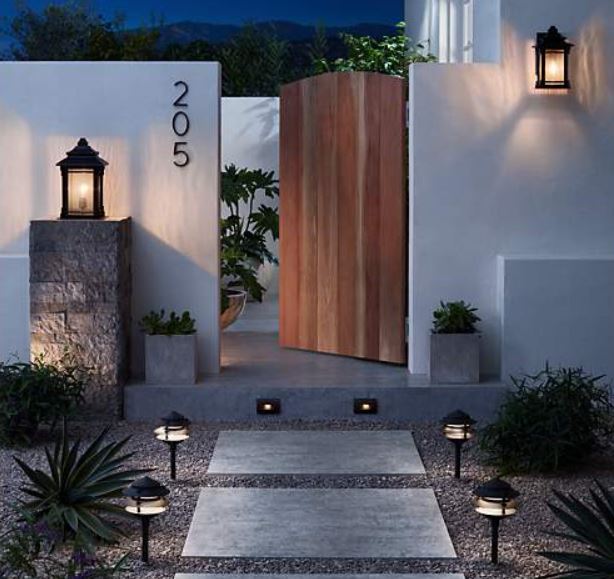
Installing a landcape lighting system is a great way to add beauty, curb appeal and safety to your home garden, walkway and entrance areas. If you have an existing system it's easy to enhance it
Here are some of the general ideas to keep in mind as you plan your system:
Select the appropriate bulbs.
A 12-volt low voltage landscape lighting system, which requires a transformer, has a number of advantages for the average or smaller property. Installing such a system is a simple do-it-yourself project with a much lower overall cost. Low voltage systems are also more energy-efficient and often offer more light output per watt. Plus, a low voltage system has a minimal risk of electrical shock, making them ideal for garden or childen play areas.
Low voltage systems also offer minimum disturbance to lawn and garden areas. The cable can be buried without conduit and junction boxes or it can be left above ground and easily relocated as desired. As plants and trees grow, you can simply move the fixture back to maintain proper illumination. Low voltage fixtures typically mount to the ground with a stake.
On the other hand, a 120-volt line voltage landscape lighting system generally lights larger areas more brightly, and provides longer beam throws. Commercial area lighting and security lighting, for example, usually require the powerful beam throw of the 120-volt system. It is designed for permanence, and rigid installation required by local and national electrical codes.
One compromise system, where feasible, is to install a 120-volt line and then add 12-volt branches or circuits using transformers. You may want to arrange for convenient switching from house locations such as the kitchen or master bedroom. If the installation is do-it-yourself, be sure to check all local electrical codes.
These lights focus a controlled intense beam to highlight the focal points in your garden: flowers, small shrubs and statuary. This creates sparkling islands of interest in your landscape lighting plan.
Positioning the light close to an interesting surface can bring out the texture of tree bark, a masonry wall, wood shingles or an attractive door. Grazing of smooth surfaces is not usually recommended.
Light the object from the front and below to project intriguing shadows on the wall or other vertical surfaces.
When you conceal lights behind and below a tress or bush, you achieve that same wondrous effect as seeing it on a ridge silhouetted against the sky at dusk.
Underwater lighting creates dramatic effects in pools and at fountains. Install a dimmer for turning lights up to add excitement. Note: Water may be used as a mirror by lighting the area behind the reflecting surface.
Mount lighting units high up in trees or on the house to cast broad illumination over wide areas. Floodlighting enables you to entertain in your backyard or outdoor area after dark, and does double duty for security and safety. For highlighting flower beds, paths or steps, the downlight is positioned close to the ground.
Illuminating a tree or statue from two or more sides reveals the three-dimensional form in a striking perspective.
Lights aimed upwards (sometimes buried in the ground) create a highly dramatic effect akin to the theater. Use it with interesting trees, a statue or textured wall surfaces. Autumn leaves or swirling snow provide spectacular views. Focus the light on the key plants or objects in your yard.
Where you require circular patterns of light on flower beds, larger shrubbery or ground cover, spread lights cover a wider area with low-level illumination. Some units, such as these bollards, cast softly diffused lighting for patios, decks, driveways and pathways. Wall brackets provide a similar lighting function. The path or flower bed should be more illuminated than the actual fixture.
Like downlighting, but using soft light sources positioned very high up, this technique simulates the lovely effect of moonlight filtering through branches, casting attractive shadow patterns.
Illuminating side and rear entries to the house, as well as walls with easy access widows, can discourage prowlers and thieves.
Highlighting your driveway with light also improves safety and security, while the delineation creates an attractive pattern.
Floodlighting from house or trees helps discourage intruders and vandals. Where you can't conceal the light source, select units which look attractive - not industrial. Arrange for automatic timers, photocells or motion sensors.
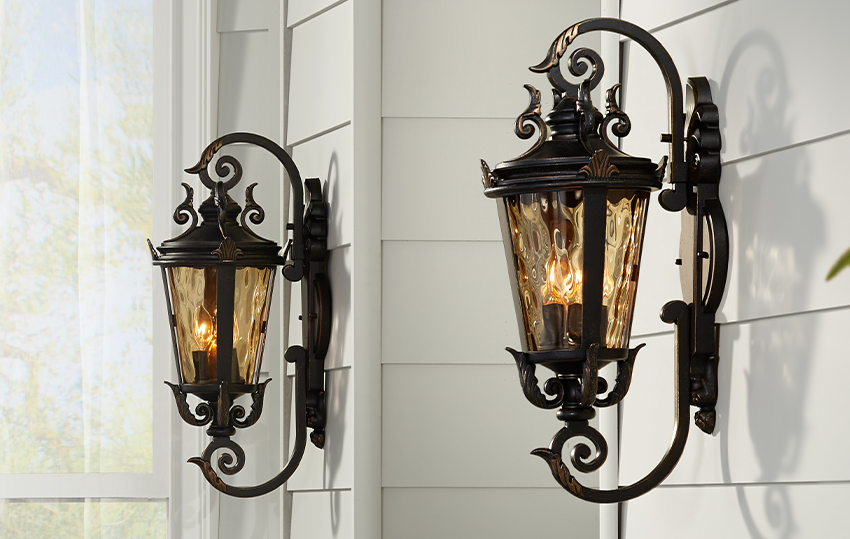
Provide a warm welcome after dark. Select a wall bracket which casts adequate illumination on front steps, as well as lighting the keyhole and house numbers.
Frequently neglected, but also important to avoid accidents in dark locations, are low path lights, post lanterns and lights attached to the house.
Ample lighting over the garage will enhance both safety and security, particularly when other lights are not on.
These designs help focus and direct the light beams. Some also cut off glare and protect the lamp and socket from debris and moisture.
These low-level units are designed to cast illumination in a broader pattern for; flower beds, perimeter plantings, driveways, steps and paths.
Burying these fixtures flush with the ground conceals the light source. Use for uplighting trees and shrubs, and grazing textured walls.
Versatile/adjustable fixtures used for uplighting, crosslighting, accenting and grazing; when mounted high up provide focused downlighting and moonlighting.
Mounted at entry doors, over garages and on porches, these Chain-hung Lantern stylish units cast light outward - either direct or diffused.
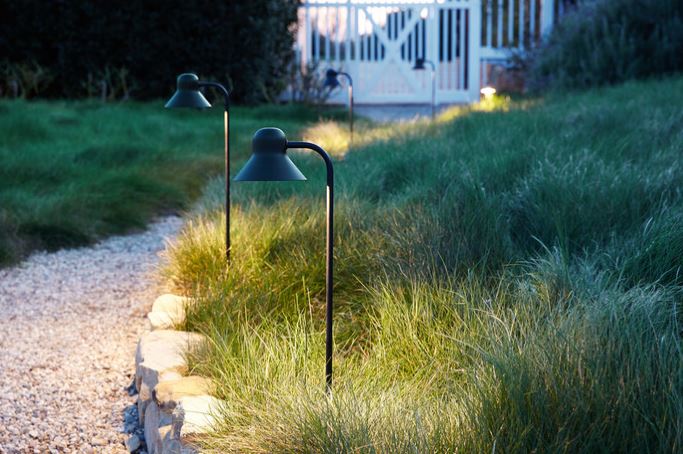
These standing fixtures light pathways, steps, garden walks, deck and pool areas. They also provide attractive light patterns for driveways.
These fixtures are installed in sides and at ends of swimming pools and bottoms of fountains. Wet niche fixtures can be removed for lamp changes, while dry niche fixtures require access to the back of the pool shell. Colored lighting is popular for this application.
Automatic timers, photocells, or motion sensors which turn lights on at dusk and off at dawn make landscape lighting convenient and energy saving. See manufacturers catalogs for other accessories which may be required.
Jeff Emerson, lighting expert from the LAMPS PLUS Professionals trade pricing program, offers these tips to achieve a professional look.
Finally, don't overlook the landscape light bulb. The wide variety of available bulbs (called "lamps" in the industry) means that you can tailor your choice to your needs. You may prefer soft illumination in some areas, bright in others. Watts are a measure of electricity consumed, but some bulbs yield more light than others of equal wattage. Remember the longer the distance of light throw, or the greater the intensity desired, the more light output will be required.
It may seem obvious that bulbs which deliver more light and are more efficient generally cost more. Some cost considerably more, but you must also compare the rated lamp life, since some lamps costing several times more usually last several times longer.
Some types are more efficient than others. Low voltage, for example, can save energy by concentrating light beams, but it generally lacks the equivalent beam throw of line voltage. Newer 65-and 120-watt incandescent bulbs yield up to 25% more light. New compact fluorescent bulbs provide soft lighting and the highest energy savings. Mercury vapor bulbs offer strong illumination with energy savings, but project a cool color suitable only for greenery.
Compact light source which provides a consistently bright light. Also available as a reflector (MR) and as a projector (PAR) type. These fit into smaller and less obtrusive fixtures.
White long tubes are primarily used for walls, banisters and signs, compact fluorescent bulbs provide a soft light quality and the highest energy saving. (Some temperature restrictions apply.)
This family, known as high-intensity discharge, provide intense light at low energy cost. Their color renditions limit use, and they do not go on immediately - they must warm up. Note: Most of the above types are available for either 120-volt or 12-volt systems, but you must specify the system. Fluorescent, Mercury Vapor and High Pressure Sodium are for 120-volt only.
Standard type commonly used around the home. Inexpensive, but yields less light than other incandescents.
Reflector type, either flood or concentrated spotlight. About twice the light output of A bulbs.
Just give us a call at 1-800-782-1967 or visit a LAMPS PLUS store near you. One of our American Lighting Association trained associates will be happy to assist you with all your landscape lighting needs.